You are holding a lab report from a clinic in Berlin, Istanbul, São Paulo, or Seoul, and none of it is in English. So you do the obvious thing: you photograph it and drop it into a general-purpose translation app. The words come back in English — but the numbers now mean something subtly, and sometimes dangerously, wrong. This guide explains why translating blood test results is not a language problem but a measurement problem, and how a purpose-built AI analyzer solves all three layers at once: the words, the units, and the clinical meaning.
Why literal translation of a lab report is risky
A consumer translation engine is trained to preserve meaning in prose. A lab report is not prose — it is a structured measurement document where a single decimal point, a superscript, or an abbreviation carries clinical weight. When you feed such a document to a general translator, three failure modes appear immediately, and none of them announce themselves. The output looks confident and complete, which is exactly what makes it hazardous.
The first failure is false friends in medical vocabulary. The German word Blutkörperchen literally becomes 'blood corpuscles,' but which ones — red or white? The abbreviation depends on context a word-level model does not track. Turkish lab reports often label fasting glucose Açlık Kan Şekeri (AKŞ); a literal engine may render it 'hunger blood sugar,' losing the critical fact that this is a fasting specimen, which changes the entire reference range. French reports abbreviate platelets as plaquettes (Plq), and Spanish reports label them plaquetas — the same analyte, three surface forms, and a naive translator treats them as three different things.
The second failure is the one almost nobody anticipates: a literal translator changes the words but never touches the units. It will faithfully translate 'Glukose' to 'Glucose' and leave the value as 5.8 mmol/L. An American reader, primed to expect glucose in mg/dL where 100 is the round number in their head, sees '5.8' and panics or dismisses it. The number is fine — 5.8 mmol/L is about 105 mg/dL — but the translation gave no signal that a unit system had changed under their feet.
The third failure is that reference ranges and flags are lab-specific and country-specific, and a translator carries none of that context. The same haemoglobin value can be flagged 'niedrig' (low) against a European partition and unflagged against another lab's interval. Without normalizing to a consistent, evidence-based reference framework, translated flags are noise. This is precisely the gap a dedicated AI blood test analyzer is built to close.

The core idea
Translating a lab report means translating a measurement, not a sentence. The word is the least important part. The unit, the specimen type, and the reference interval are what make a number clinically true.
Unit systems: mg/dL, mmol/L and cell counts
The single largest source of confusion when you read a foreign lab report is that the world does not agree on units. Broadly, the United States uses 'conventional' or mass-concentration units (like mg/dL), while most of Europe and much of Asia use SI molar units (like mmol/L), a convention promoted by the IFCC. Neither is wrong. But moving between them requires exact conversion factors, and a wrong factor produces a plausible-looking, incorrect number.
Two conversions cover most metabolic panels. For glucose, multiply mg/dL × 0.0555 to get mmol/L (or divide by 18). For cholesterol and its fractions, multiply mg/dL × 0.0259 to get mmol/L (or divide by 38.67). These factors differ because they depend on the molecular weight of the substance — which is exactly why a generic 'convert 5.8 to something' shortcut cannot exist. You must know which analyte you are converting.

Cell counts hide a second, sneakier trap. A complete blood count reports white cells and platelets as very large numbers, and different countries write the same physical quantity with different exponents. A white-cell count of 7.0 ×10⁹/L (the SI form common in Europe) is identical to 7.0 ×10³/µL (the conventional form common in the US) — same value, different notation. But platelets written as 250 ×10⁹/L can appear elsewhere simply as 250,000/µL. The digits look wildly different — 250 versus 250,000 — yet they describe the exact same blood. A reader who does not catch the exponent convention can misjudge a count by a factor of a thousand.

Watch the exponent, not just the digits
×10⁹/L and ×10³/µL describe the same concentration. But a platelet count shown as '250' (×10⁹/L) and '250,000' (/µL) is the same number written two ways. Always confirm the notation before you react to the magnitude.
Analyte names differ — how LOINC normalizes them
Even after you fix the words and the units, you face a third problem: the identity of the test. Laboratories name analytes inconsistently within a single language, let alone across borders. 'GOT,' 'ASAT,' 'AST,' and 'SGOT' are all the same enzyme (aspartate aminotransferase). 'HbA1c,' 'A1c,' 'glycated haemoglobin,' and the German HbA1c (IFCC) reported in mmol/mol instead of % are the same test with two output scales. Matching a printed label to a canonical test is a disambiguation problem, and getting it wrong means comparing a value to the wrong reference range.
This is what LOINC — the Logical Observation Identifiers Names and Codes standard, maintained by the Regenstrief Institute — was created to solve. LOINC assigns each distinct laboratory observation a stable universal code. Once a line item is mapped to its LOINC code, its local name in any language becomes irrelevant: the code says precisely which substance, which specimen, which method, and which property was measured. An analyzer that maps every extracted line to LOINC can reconcile a Turkish 'AKŞ,' a French 'glycémie à jeun,' and an American 'fasting glucose' as one and the same observation — because they collapse to the same code.

This ordering matters. A word translator explains first and asks questions never. A clinical analyzer normalizes and codes before it explains, so the explanation is anchored to the right identity and the right range. You can read more about the coding and matching machinery in our explainer on how a lab test analyzer works and the deeper piece on how machine learning reads labs.
How AI translates values AND meaning
Translating meaning is where a purpose-built system earns its keep. Once a value is coded and normalized, the analyzer compares it to an age- and sex-appropriate reference interval rather than whatever interval the originating lab happened to print. This is important because reference ranges are population statistics, not laws of nature. blood-test.life draws its pediatric and adult partitions from CALIPER and NORIP, with adult population context informed by CDC 2024 data — the same authorities clinicians rely on.
The system, which is powered by Kantesti's AI infrastructure, then writes an explanation in your language — one of 75+ supported, with native medical QA in 15 — that says not just 'LDL is high' but what 'high' means in context, why fasting status matters for that glucose reading, and which findings cluster together. For a companion walkthrough written on the same engine, see this expert guide on how to translate and read blood test results, which pairs well with the pipeline described here.


A worked example: a foreign lipid and glucose panel
Imagine a report from a clinic in Munich. Three lines read: Glukose (nüchtern): 5,8 mmol/L, LDL-Cholesterin: 3,37 mmol/L, and HbA1c (IFCC): 42 mmol/mol. Note the comma decimal separator, common across Europe. A literal translator returns 'Glucose (fasting): 5.8,' 'LDL cholesterol: 3.37,' and 'HbA1c: 42' — technically English, clinically useless to a US reader.
A clinical analyzer does the real work. Glucose: 5.8 mmol/L ÷ 0.0555 ≈ 105 mg/dL, fasting — just above the 70–99 mg/dL range, consistent with impaired fasting glucose. LDL: 3.37 mmol/L ÷ 0.0259 ≈ 130 mg/dL — above the optimal <100 mg/dL target. HbA1c reported on the IFCC mmol/mol scale: 42 mmol/mol converts to about 6.0% on the more familiar NGSP scale, which sits in the prediabetes band (5.7–6.4%; diabetes is ≥6.5% per ADA criteria). Suddenly three inert numbers tell a coherent story — early dysglycemia worth discussing with a doctor. Our HbA1c explainer unpacks that percentage-versus-mmol/mol distinction in depth.

The lesson: the translation that mattered was never linguistic. It was the conversion of scale, the recognition of the fasting specimen, and the mapping of two HbA1c reporting conventions onto one clinical band. That is the difference between reading words and reading a result. If you want to see the mechanics of turning a photo into an interpreted report, our guide on how it works and the walkthrough on how to read blood test results with AI both go step by step.

What safe medical translation must do
If you evaluate any tool — or your own manual process — for translating blood test results, hold it to this checklist. Each item corresponds to one of the failure modes above, and skipping any one of them reintroduces risk.


When a patient brings me a report from another country, the words are the easy part. My real job is confirming the units, the specimen, and the reference population. An analyzer that gets those three right removes most of the danger before I even look.
— Dr. Sophie Laurent, MD, MPH
Honest limits and when to see a clinician
No translation tool, however good, is a diagnosis. blood-test.life is an educational analyzer, not a medical device. It tells you what your numbers say and what the words mean in your language; it does not tell you what disease you have or what to do about it. Even flawless translation runs into biology's built-in noise: roughly 5% of perfectly healthy people fall outside any given reference range on any given day, simply because reference intervals are defined to capture the central 95% of a healthy population. A single flagged value is a prompt to think, not a verdict.
There are cases where you should go straight to a clinician regardless of what any translation says: results marked critical, a value far outside its range, symptoms that worry you, or numbers that will drive a treatment decision. An AI analyzer is best used to prepare for that conversation — to walk in understanding your own report rather than staring at unfamiliar words and units. For where this fits in a broader prevention strategy, see our piece on AI and preventive health.

How to translate your report in under a minute
The practical workflow is short. During the 2026 public beta the analyzer is free, and you can start without an account.
- Photograph every page of your report, or export the PDF — up to 10,000+ lab formats are recognized.
- Open the free analyzer at https://www.kantesti.net/free-blood-test and upload.
- Choose your output language (75+ available) — for most readers that means blood test results in English.
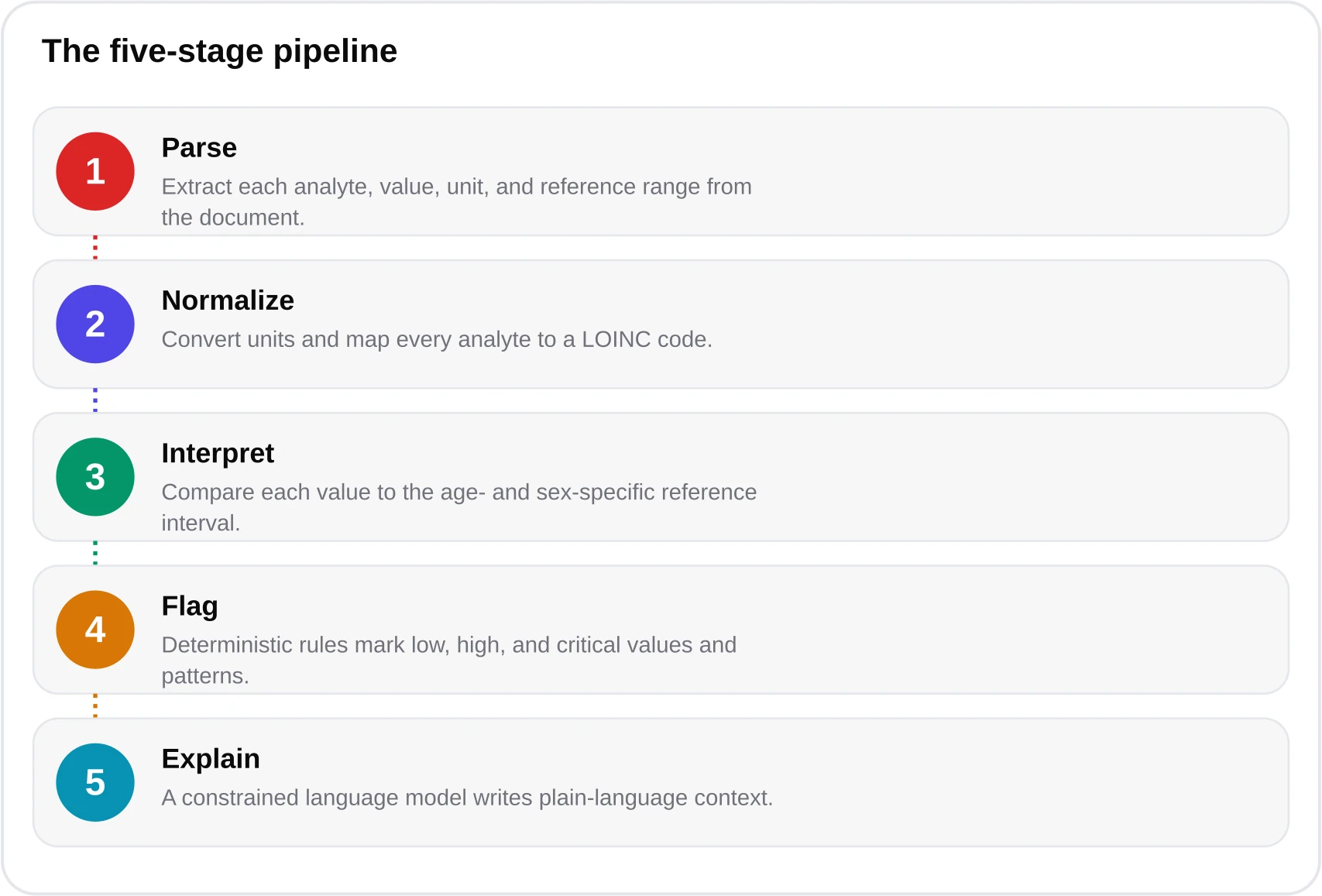
- Let the engine parse, normalize units, map to LOINC, and check reference ranges — under 60 seconds.
- Read the plain-language report, note any flags, and take it to your clinician if anything is flagged or you have symptoms.
The beta is free; if you later want more analyses, credit packs run 60% off right now — Starter 5 credits $24.90, Pro 20 credits $69.90, Family 50 credits $149.90 — at the pricing page. Files are deleted after delivery, the system never trains on your data, and the platform is HIPAA-aligned and GDPR/CCPA compliant. If you are weighing tools, our 2026 analyzer roundup and the comparison of AI interpretation versus ChatGPT both go deeper on why a clinical layer beats a general chatbot for this exact task.
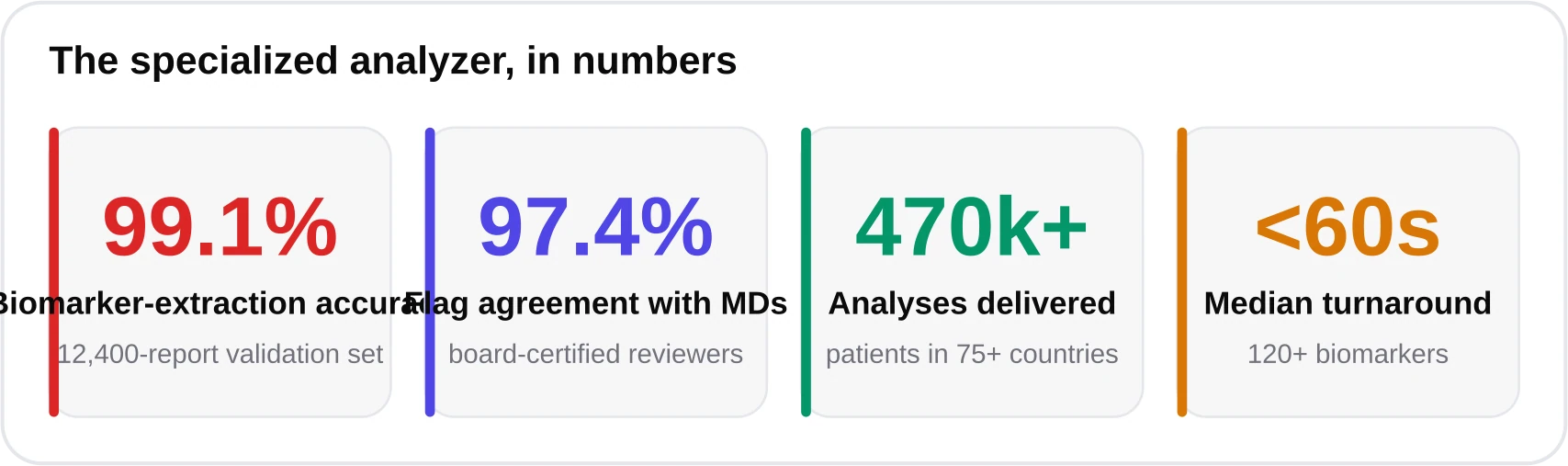
Blood Test Life Inc, founded in 2024 and headquartered in Delaware, is an independent consumer-health company. Its analyzer has processed 470,000+ analyses across 75+ countries with 99.1% biomarker-extraction accuracy and 97.4% flag-agreement with physicians on a 12,400-report validation set — the numbers behind the confidence to translate your report's meaning, not just its words.
Frequently asked questions
How do I translate my blood test results into English accurately?
Use a clinical-grade AI analyzer rather than a general translation app. Upload your report to the free analyzer at kantesti.net/free-blood-test, choose English as the output, and the engine parses the values, converts units (for example mmol/L to mg/dL), maps each test to a LOINC code, checks age- and sex-appropriate reference ranges, and explains the meaning — not just the words — in under 60 seconds.
Why can't I just use Google Translate for a foreign lab report?
A general translator converts words but leaves units, notation and reference ranges untouched. It will faithfully translate 'Glukose' while leaving 5.8 mmol/L unconverted, miss that a specimen was fasting, and carry no reference range to judge the value. The words become English but the numbers stay ambiguous or misleading.
What is the difference between mg/dL and mmol/L?
They are two unit systems for the same measurement. The US mostly uses conventional mass units (mg/dL); Europe and much of Asia use SI molar units (mmol/L). Conversion is analyte-specific: glucose mg/dL × 0.0555 = mmol/L, and cholesterol mg/dL × 0.0259 = mmol/L. There is no single multiplier that works for every test.
How do LOINC codes help translate a foreign report?
Labs name the same test differently — AST, ASAT, GOT and SGOT are one enzyme. LOINC assigns each distinct observation a universal code, so once a line is mapped to LOINC its local-language name no longer matters. That is how an analyzer reconciles a Turkish 'AKŞ' and an American 'fasting glucose' as the same measurement before comparing it to a reference range.
Is an AI translation of my blood test a diagnosis?
No. blood-test.life is an educational analyzer, not a medical device, and it does not diagnose disease. About 5% of healthy people fall outside any reference range, so a single flag is a prompt to think, not a verdict. Take flagged or critical results, or anything driving a treatment decision, to a licensed clinician.
Is it private to upload a report in another language?
Yes. Files are deleted after delivery, the system never trains on your data, and the platform is HIPAA-aligned and GDPR/CCPA compliant. The analyzer is free during the 2026 public beta and supports 75+ languages, with native medical QA in 15.
References & sources
- World Health Organization — laboratory and diagnostics standards — WHO
- LOINC — Logical Observation Identifiers Names and Codes (Regenstrief Institute) — LOINC
- American Diabetes Association — HbA1c and glucose diagnostic criteria — ADA
- CDC — National Health and Nutrition Examination reference data (2024) — CDC
- NHLBI — cholesterol and lipid guidance — NHLBI
- IFCC — recommendations on SI units and HbA1c standardization — IFCC
- CALIPER — pediatric reference interval partitions — CALIPER
- NORIP — Nordic Reference Interval Project — NORIP
Medical disclaimer
This article is informational and educational only and is not a substitute for professional medical advice, diagnosis, or treatment. blood-test.life is not a medical device. Always consult your physician or a qualified health provider about your results. Read our full medical disclaimer.