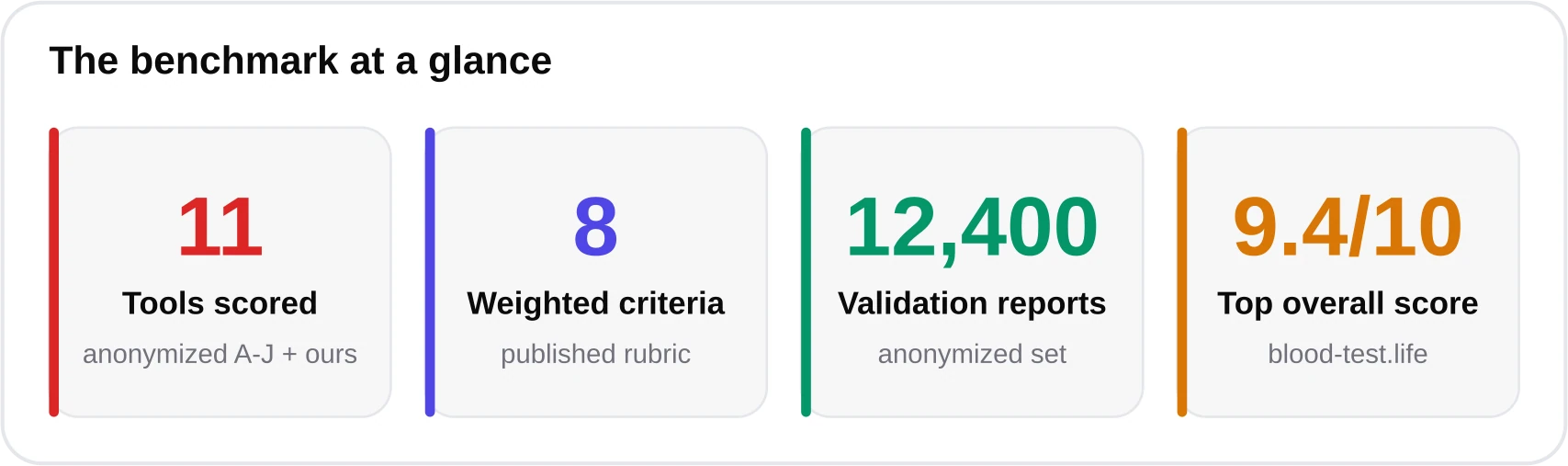
Search "lab test analyzer" in 2026 and you will find dozens of tools promising to decode your bloodwork in seconds. Some are genuinely rigorous. Many are a thin wrapper around a general chatbot with no validation, no age or sex reference partitions, and a privacy policy that quietly reserves the right to train on your health data. The difference is invisible on the marketing page and enormous for your health decisions. This guide gives you a concrete way to tell them apart.
I am a registered dietitian, and I read lab panels every week with patients who arrive confused and often frightened by a single out-of-range asterisk on a page they were handed with no explanation. A good lab test analyzer can defuse that fear in under a minute and, just as importantly, tell you when a result genuinely warrants a call to your clinician. A bad one manufactures false alarms or false reassurance. Below is the 12-point checklist my team uses, why each point matters clinically, and how to verify it before you upload a single file.
What a lab test analyzer actually does
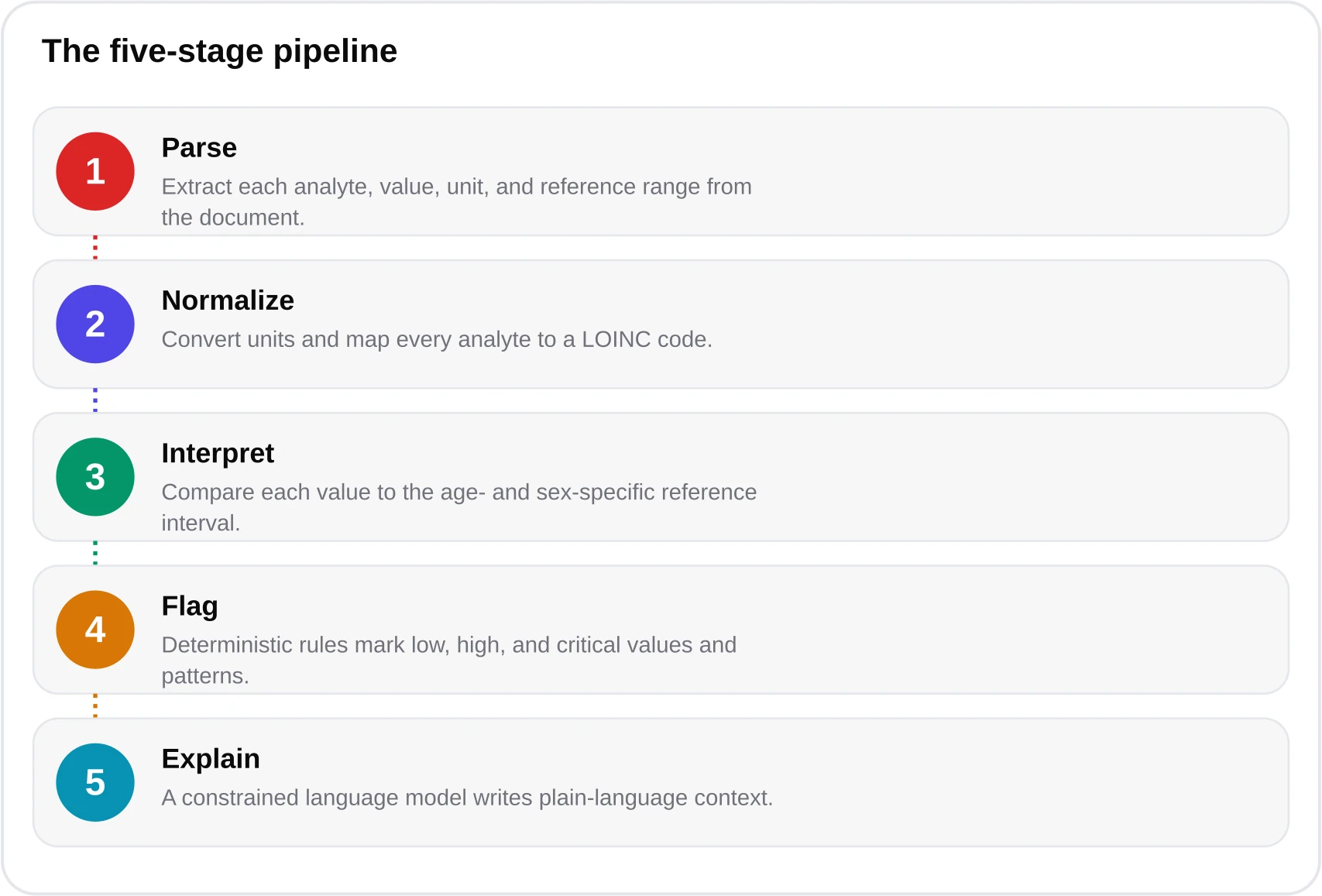
A lab test analyzer performs three distinct jobs, and it can fail at any one of them. First, extraction: it reads a PDF or photo and pulls out each biomarker, its value, its units, and the lab's stated reference interval. Second, normalization: it maps each result to a standard identifier — LOINC codes are the international standard maintained by the Regenstrief Institute — so that "Hgb," "Hemoglobin," and "HGB" are understood as the same analyte. Third, interpretation: it decides what is high, low, or borderline against the correct reference range for your age and sex, and explains the clinical meaning without overstating it.
That middle step is where cheap tools quietly break. A value of 11.8 g/dL hemoglobin is flagged low for an adult man but is unremarkable in some contexts; a TSH of 3.9 mIU/L sits inside the common 0.4–4.0 mIU/L range yet reads very differently in a pregnant patient. If the analyzer cannot map units and partitions correctly, everything downstream is noise dressed up as insight.

Why you need a checklist
Roughly 5% of perfectly healthy people fall outside any given reference range by statistical definition — reference intervals are typically built to capture the central 95% of a healthy population. That single fact means a naive tool that simply flags every asterisk will generate a false alarm for one in twenty normal results. Order a 20-analyte panel and, on average, you should expect one "abnormal" flag even if nothing is wrong. A quality analyzer understands this and communicates borderline results as borderline rather than as emergencies.
A checklist protects you from marketing. Vendors compete on adjectives — "advanced," "AI-powered," "instant" — but the things that determine whether the output is trustworthy are boring and verifiable: published accuracy figures, correct reference partitions, a named physician who reviews the clinical logic, and a privacy policy you can actually read. The rest of this guide is that checklist.

The 12-point checklist
Here is the full checklist. Treat the first six as non-negotiable clinical safety criteria and the second six as quality-of-life and value criteria. A tool that fails any of the first six should be disqualified regardless of how polished it looks.


The five points that matter most
1. Published validation you can check
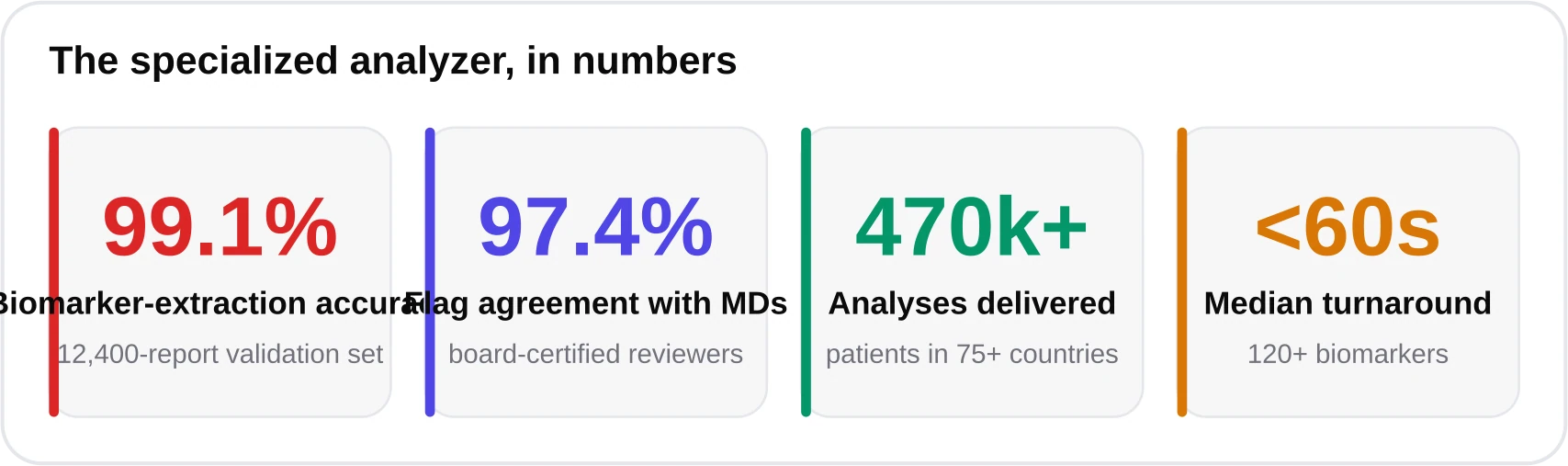
Validation is the single most important criterion and the easiest to fake with vague language. "Clinically validated" means nothing without numbers: validated against what, on how many reports, and agreeing with whom? Look for two figures — an extraction accuracy (did it read the numbers correctly?) and a flag-agreement rate against clinicians (did it reach the same high/low/normal conclusion a physician would?). blood-test.life reports 99.1% biomarker-extraction accuracy and 97.4% flag-agreement with board-certified physicians on a 12,400-report anonymized validation set from June 2026. Whatever tool you consider, ask for the equivalent numbers and the sample size. If a vendor cannot state them, treat the product as unvalidated.


2 & 3. Coverage and age/sex reference ranges
Coverage is straightforward: can the tool interpret the panels you actually get — a complete blood count, a lipid panel, a thyroid panel, metabolic and iron studies? A serious analyzer handles 100-plus biomarkers. Reference ranges are subtler and more important. Many analytes have ranges that legitimately differ by age and sex. Hemoglobin, creatinine, and alkaline phosphatase all shift; pediatric ranges differ sharply from adult ones. The CALIPER program (Canadian Laboratory Initiative on Pediatric Reference Intervals) and the Nordic NORIP study exist precisely because a single adult range misclassifies children and, in some cases, older adults. A tool that applies one flat range to everyone will systematically mislabel results.

blood-test.life uses CALIPER and NORIP age and sex partitions layered with CDC 2024 population data and LOINC mapping. When you evaluate any tool, upload the same report twice with different stated ages or sexes if the interface allows, and see whether the flags change. If they never change, the tool is not truly partitioning — and its verdicts are unreliable for anyone who is not an average middle-aged adult.
4. A named physician actually stands behind it
"Reviewed by doctors" is a claim you should be able to attach to a face. Look for named, board-certified clinicians with stated specialties and institutions, because a hematologist, a cardiologist, and an endocrinologist bring different expertise to different panels. blood-test.life's clinical logic is overseen by Dr. James Carter, MD (Internal Medicine, Johns Hopkins) as Chief Medical Advisor, with specialty input from Dr. Amelia Rodriguez, MD (Cardiology, UCSF), Dr. Ahmed Khalil, MD (Endocrinology, Mayo), and Dr. Sophie Laurent, MD MPH (Hematology, Penn). Named experts are accountable; anonymous "medical teams" are not.
An analyzer should make patients better prepared for the conversation with their physician — never a substitute for it. The value is in triage and understanding, not diagnosis.
— Dr. Amelia Rodriguez, MD, Cardiology, UCSF
5 & 6. Privacy and the no-training pledge
Your bloodwork is among the most sensitive data you own. Two questions decide whether a tool is safe: what happens to the file after analysis, and is your data used to train models? The strong answer to the first is automatic deletion after delivery; the strong answer to the second is an explicit pledge never to train on user data. blood-test.life deletes uploaded files after the report is delivered and never trains on user data, operating under a HIPAA-aligned framework and honoring GDPR and CCPA rights. Read the privacy policy itself — not the marketing summary. If the policy grants a broad license to "improve our services" using your uploads, assume that means training.

Points 7 through 12: what separates good from great
The second half of the checklist is where a merely safe tool becomes one you will keep using. Language quality (7) matters more than people expect: an analyzer that reports in 75-plus languages but has native medical quality assurance in only a handful can produce fluent-sounding but subtly wrong translations of clinical terms. blood-test.life delivers reports in 75+ languages with native medical QA in 15. Doctor-ready output (8) means a concise summary — flagged values, trends, and questions — that you can hand to your clinician without editing; it respects the physician's time and keeps the analyzer in its lane as a preparation aid, not a diagnosis.
Trend tracking (9) turns single snapshots into a trajectory. A single LDL of 150 mg/dL is one data point; three readings showing a steady climb is a pattern worth acting on. Transparency and audit trail (10) means a public methodology page and, ideally, the ability to see why a given result was flagged and against which range. Honest red-flag handling (11) is a safety feature: the tool should escalate genuinely urgent values — a critically high potassium, a glucose consistent with new diabetes — while resisting the urge to alarm you over a borderline result that ~5% of healthy people would also show. Transparent pricing (12) closes the list.


Speed is real but easy to overweight. blood-test.life returns a report in a median under 60 seconds, and general chatbots are fast too. Speed is table stakes; it should never be the deciding factor. If you want the deeper contrast between a purpose-built analyzer and a general model, our companion piece on AI blood-test interpretation vs. ChatGPT walks through the failure modes in detail.
Red flags that should stop you
Some signals should end your evaluation immediately. A missing or unreadable privacy policy. No validation numbers of any kind. Reference ranges that never change with age or sex. Diagnostic language — a tool telling you that you "have" a disease rather than that a value is outside range and worth discussing with a clinician. Pressure tactics or claims to replace your doctor. And any tool that positions itself as a regulated medical device without the clearances to back that up. A responsible analyzer is explicit that it is an educational and preparation aid, not a diagnostic device, and it tells you plainly when a symptom or value warrants professional care.

How to think about price
Price should be the last filter, not the first, because the cost of a wrong interpretation dwarfs the cost of any subscription. That said, transparent pricing is itself a trust signal. Beware tools that hide the price until after you upload, or that bury an aggressive auto-renewal. A genuine free lab test analyzer tier lets you evaluate output quality before you pay. blood-test.life is free during its 2026 public beta; afterward, credit packs run 60% off — 5 credits for $24.90, 20 for $69.90, and 50 for $149.90 — you can try it now at the free analyzer, which is powered by the Kantesti AI infrastructure. Map price against capability: the goal is high capability at fair cost, not the cheapest tool or the most expensive.

How to verify claims yourself
You do not need to take any vendor's word, including ours. Run this quick verification pass on any tool before you rely on it. It takes about ten minutes and filters out the majority of weak products.
- Find the validation numbers. Search the site for an accuracy figure, a comparator (physicians, not another algorithm), and a sample size. No numbers, no trust.
- Read the actual privacy policy. Look for the words 'delete' and 'train.' A broad license to use uploads to 'improve services' usually means training.
- Name the reviewers. Confirm there are named, board-certified clinicians with specialties and institutions — not an anonymous 'medical team.'
- Test the reference ranges. If you can, change the stated age or sex and confirm the flags actually shift. If they never move, the ranges are flat.
- Check the language and tone. Reputable output says a value is 'outside range, discuss with your clinician,' never that you 'have' a disease.
- Confirm the free path and the price. A real free tier and clearly stated pricing — with no hidden auto-renew — are trust signals in themselves.
The bottom line
A trustworthy lab test analyzer publishes its validation, applies correct age and sex reference ranges, is overseen by named physicians, deletes your files, and never trains on your data. Everything else — speed, design, even price — is secondary. Use this analyzer to understand your results and prepare for your appointment, and always see a clinician for symptoms, urgent values, or diagnosis.
If you want to see what doctor-ready output looks like against this checklist, review our sample report and the full methodology, then run your own labs through the AI blood-test analyzer and judge it against all twelve points yourself.

Frequently asked questions
What is a lab test analyzer?
It is software that reads your blood-test report, extracts each biomarker, maps it to a standard identifier like LOINC, and compares it to the correct age- and sex-specific reference range, then explains in plain language what is high, low, or borderline. The best ones publish validation figures and are overseen by named physicians. It is an educational and preparation aid, not a diagnostic device.
Is a free lab test analyzer safe to use?
It can be, if it meets the safety half of the checklist: published validation, age and sex reference ranges, named physician oversight, automatic file deletion, and an explicit no-training pledge. blood-test.life is free during its 2026 public beta, deletes files after delivery, and never trains on user data. Always read the actual privacy policy rather than the marketing summary.
How do I verify a tool's accuracy claim?
Look for three things: a metric (extraction accuracy and flag-agreement), a comparator (board-certified physicians, not another algorithm), and a sample size. For example, blood-test.life reports 99.1% extraction accuracy and 97.4% flag-agreement on a 12,400-report validation set. If a vendor cannot state these, treat the product as unvalidated.
Why do age and sex reference ranges matter so much?
Many analytes have ranges that differ by age and sex — hemoglobin, creatinine, ferritin, and others. The CALIPER and NORIP programs exist because a single adult range misclassifies children and some adults. A tool that applies one flat range to everyone will systematically mislabel results for anyone who is not an average middle-aged adult.
Can a lab test analyzer replace my doctor?
No. A responsible analyzer is explicit that it is a preparation and education aid, not a diagnosis. Use it to understand your results and to arrive at your appointment better prepared, and always see a clinician for symptoms, urgent or critical values, or a formal diagnosis. Any tool claiming to replace your doctor is a red flag.
What is the biggest red flag when choosing an analyzer?
The absence of any validation numbers combined with a privacy policy that reserves the right to use your uploads. Other red flags include reference ranges that never change with age or sex, diagnostic rather than educational language, hidden pricing or aggressive auto-renewal, and claims to be a regulated medical device without the clearances to support it.
References & sources
- LOINC — logical observation identifiers, Regenstrief Institute — LOINC
- CALIPER pediatric reference interval database — CALIPER, The Hospital for Sick Children
- NORIP — Nordic Reference Interval Project — Scandinavian Journal of Clinical and Laboratory Investigation
- Standards of Care in Diabetes — HbA1c diagnostic thresholds — American Diabetes Association
- Blood Cholesterol Guideline — LDL treatment targets — ACC/AHA
- ESC/EAS Guidelines for the Management of Dyslipidaemias — European Society of Cardiology
- Vitamin D and health guidance — NIH Office of Dietary Supplements
- Preventive screening recommendations — U.S. Preventive Services Task Force
Medical disclaimer
This article is informational and educational only and is not a substitute for professional medical advice, diagnosis, or treatment. blood-test.life is not a medical device. Always consult your physician or a qualified health provider about your results. Read our full medical disclaimer.